Justice Action Update #10
Entering a New Phase for the Justice Action Coalition
The Justice Action Coalition (JAC) is entering an exciting new chapter. Since its launch in 2021, the Coalition has grown into a dynamic, high-ambition alliance of countries and partners committed to advancing people-centered justice and closing the global justice gap. Today, as we move beyond the inception of our permanent structure and into a new strategic phase through 2030, we are building on strong foundations to deepen impact, scale innovation, and strengthen our countries’ leadership worldwide.This update provides an overview of the Coalition’s journey to date, key achievements from the 2024–2025 inception phase, and our strategic priorities for 2026–2030.
From Vision to Coalition
Following the recommendation of the Justice for All report to convene a group of countries committed to leading on justice, the Justice Action Coalition was created in April 2021. The JAC is a multi-stakeholder, high-ambition alliance of countries and partner organizations committed to advancing people-centered justice and closing the global justice gap. The Coalition serves as a platform for collaboration, learning, normative alignment, and political leadership at the intersection of justice, human rights, and sustainable development.
At its core, the JAC aims to achieve measurable progress in justice outcomes for people and communities. Its strategic purpose encompasses:
- Closing the Global Justice Gap: Reducing the disconnect between justice needs and justice provided—a challenge affecting billions worldwide.
- People-Centered Justice: Shifting the frame of justice reforms toward approaches grounded in people’s perspectives, needs, and outcomes, with an emphasis on inclusion and equity.
- Collective Action and Political Leadership: Elevating justice as a priority in global and regional agendas and mobilizing collective commitments, resources, and political will among member states and partners.
The Coalition has steadily grown and currently brings together 19 countries and 23 partner organizations that are all united behind a shared vision of justice systems that are accessible, equitable, responsive, and trusted.
Looking Towards 2030: JAC’s Vision
By 2030, the Justice Action Coalition aims to help create a world in which people-centered justice is embedded in national policies and development strategies, and where measurable improvements in access to justice are visible in the lives of communities, particularly those most marginalized. Through strengthened country leadership, robust evidence, sustainable financing, and a vibrant global coalition, JAC will contribute to justice systems that are more accessible, responsive, and trusted.
The Permanent Structure: Inception Phase (2024–2025)
In January 2024, the Coalition launched its permanent structure, with four thematic workstreams:
- Data & Evidence: Led by the OECD, in collaboration with the World Justice Project and The Hague Institute for Innovation of Law (HiiL), focused on establishing robust measurement frameworks and strengthening the evidence base on people-centered justice.
- Strategy, Programming, & Innovation: Led by the United Nations Development Programme (UNDP), emphasizing co-creation of national justice strategies and support for innovative justice solutions.
- Communication & Narrative: Led by Pathfinders, advancing shared messaging, advocacy, and linkage of justice to broader governance agendas.
- Justice Financing: Led by Pathfinders, in collaboration with HiiL and ODI Global, focused on reframing how justice systems are financed to deliver inclusive, people-centered outcomes.
Pathfinders also led the Coalition’s governance functions, supporting the establishment of a Board composed of member countries and partner representation.
As the Coalition enters its next phase in 2026, Pathfinders will continue to serve as the Secretariat of the Justice Action Coalition to ensure continuity, coherence, and strategic coordination across workstreams, governance, and country engagement.
Achievements to Date
Over the past two years, the Coalition has moved from concept to implementation, establishing a durable platform, advancing a shared reform agenda, and translating global commitments into concrete country action.
- Building the Platform and a Narrative
A durable, high-ambition coalition
- Established a structured and sustained mechanism for collaboration among member states and partner organizations.
- Enabled coordinated engagement, collective leadership, and long-term alignment around people-centered justice and Sustainable Development Goal 16.3.
- Convened regular Expert-Level, Senior-Level, and High-Level Meetings to exchange domestic experiences, align international advocacy, and provide strategic direction.
A shared narrative for reform
- Developed a common language on people-centered justice, aligning political messaging, technical framing, and advocacy across members and partners.
- Articulated a coherent narrative that positions people-centered justice as both a governance imperative and a development accelerator.
- Equipped members with harmonized key messages and communication tools to ensure consistency across global, regional, and national engagements.
- Key deliverables include:
- Communications Toolkits with Free Resources in an Accessible Platform
- Advocacy Tools with “Key Messages on People-Centered Justice” and “Actions to Achieve People-Centered Justice,” in English and Spanish
- Key Takeaways on Communicating Across Disciplines: How to Make Justice Matter to All
- Videos on Actions to Achieve People-Centered Justice, which featured:
- Fernando Marani, Program Director of Justice, Inclusion and Equality, Pathfinders
- Clare Manuel, Senior Research Associate, ODI Global
- Maaike de Langen, Senior Policy Advisor, OECD
- Revai Makanje Aalbaek, Senior Advisor on Justice and Security, Rule of Law, Security, Human Rights Team, UNDP Crisis Bureau
- Policy dialogues across national, regional, and global levels to sustain momentum
Political visibility at the highest levels
- Advanced joint statements on people-centered justice at United Nations conferences and forums, including:
- Justice Action Coalition Statement at SDG16 Conference 2024
- Justice Action Coalition Statement on the importance of equal access to justice for all issued during the Summit of the Future (2024)
- Justice Action Coalition Statement at SDG16 Conference 2025
- Justice Action Coalition Statement at the 2025 High-level Political Forum
- 80th Session of the General Assembly of the United Nations, 6th Committee (2025)
- Justice Action Coalition Statement at the 2025 World Summit for Social Development
- Promoted people-centered justice and policy positioning at major global events, including:
- OECD Global Roundtable on Equal Access to Justice
- World Justice Forum
- Global and regional OGP meetings
- Sustained high-level political attention to people-centered justice across global milestones.
- Strengthening the Evidence and Financing Pillars
The Coalition mobilized thematic workstreams that address two structural constraints in justice reform, moving the agenda from normative commitment to operational implementation:
- Data & Measurement: Improving justice data systems to support decision-making and accountability.
- Justice Financing: Advancing practical frameworks to increase domestic and international investment in justice.
Key deliverables include:
- The Economic Case for People-Centered Justice: Fact Sheet
- The People-Centered Justice Measurement Framework: Fact Sheet
- The Justice Financing Framework: Fact Sheet
Together, these tools strengthen the evidence base, define measurable outcomes, and clarify the financing pathways needed for sustainable reform.
3. Catalyzing Country-Level Reform
From global commitment to national transformation
Through the Catalytic Fund, the Coalition translated political commitments into targeted national action.
Initial portfolio: Nine countries—Colombia, Dominican Republic, Kenya, Samoa, São Tomé and Príncipe, Sierra Leone, Ethiopia, Malawi, and Saint Kitts and Nevis.
- Provided financial and technical support for locally driven justice initiatives.
Demonstrated how small, strategic investments can:
- Unlock institutional innovation.
- Strengthen justice delivery for marginalized communities.
- Generate scalable lessons for systemic reform.
Further resources:
- Project Portfolio Highlights
- Catalytic Fund: Fact Sheet
In just two years, the Coalition has:
- Built a credible inclusive platform.
- Defined the analytical and financing architecture for reform.
- Catalyzed concrete country-level change.
- Elevated people-centered justice in global policy discourse.
The foundation is now firmly in place for scaling impact in the next phase.
Strategic Focus for 2026–2030
The Roadmap
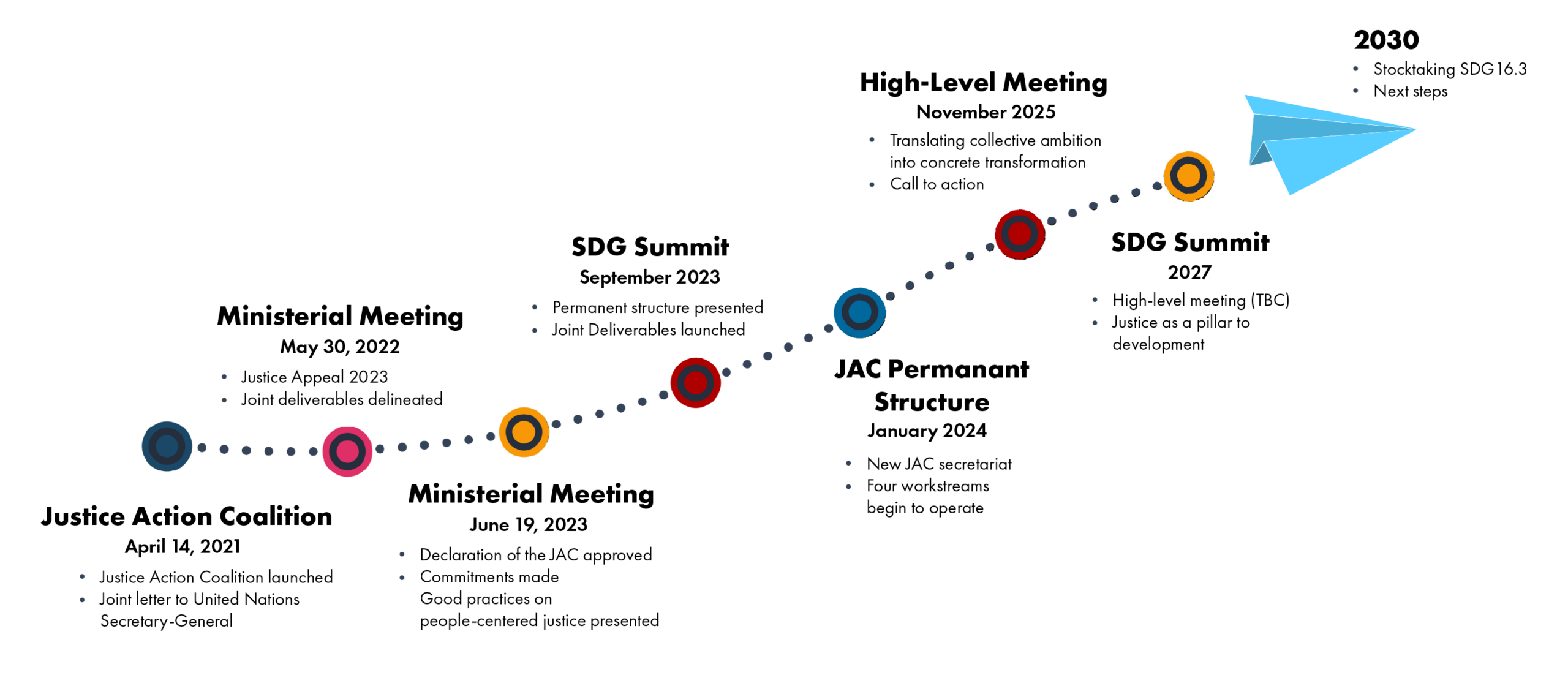
As we approach the final stretch of Agenda 2030, urgency is growing. Billions continue to face unresolved justice needs that undermine social cohesion, economic opportunity, and trust in institutions. At the same time, recognition of people-centered justice as a driver of sustainable development is stronger than ever.
The next phase for the Justice Action Coalition will focus on deepening impact, scaling successful approaches, and embedding people-centered justice within national systems.
Data & Evidence
The focus will shift from framework development to operationalization and uptake. The Justice Measurement Framework will be finalized and implemented, with scalable data collection across OECD and JAC countries. Updated guidance on legal needs surveys and justice statistics will strengthen comparability while respecting national contexts. Economic methodologies will support governments in making the investment case for reform.
Implementation & Catalytic Fund
The Implementation Workstream will accelerate national action by supporting strategic pilots, fostering innovation, strengthening institutional capacity, and generating practical learning. In a context of constrained development budgets, the Catalytic Fund offers a cost-effective mechanism to maximize impact through targeted, country-led initiatives aligned with JAC priorities.
Communications & Narrative
The Communications workstream will refine and amplify shared messaging on people-centered justice, identify key global moments for engagement, and equip countries and partners with tools to engage stakeholders beyond the justice sector. Workshops, expert discussions, and tailored support will help strengthen justice communications strategies domestically and internationally.
Justice Financing
The Justice Financing Framework (JFF) will enter a piloting phase, with countries integrating elements of the Framework into budgeting and reform processes. Pilots will include evaluation components to generate lessons and refine benchmarks and tools. Through peer learning and convening, Pathfinders, HiiL and ODI Global will build a community of practice around justice financing to accelerate global uptake.
Across all workstreams, emphasis will be placed on integration, peer exchange, co-creation, and regional engagement, ensuring that global commitments translate into measurable national outcomes.
Renewed Modalities
Building on the achievements of its first two phases, the Justice Action Coalition enters 2026–2030 with a strong foundation of political leadership, partnerships, and practical experience.
We are excited to share that the Justice Action Coalition will be launching a new set of Thematic Tracks in 2026, marking an important step in deepening collaboration and sharpening our collective impact.
In March, the Coalition will begin developing the concepts and terms of reference for each track, while also identifying the member countries and partner organizations that will serve as co-leads of the tracks. These tracks will provide focused platforms for advancing priority areas, strengthening peer exchange, and accelerating implementation across the Coalition.
We warmly encourage stakeholders to engage with these new initiatives as they take shape. Further details will be shared soon and we look forward to this next phase of dynamic, collaborative action.
Further, lessons learned demonstrate that sustained progress requires coordinated global, regional, and local advocacy, country-led implementation, stronger evidence and financing, and a durable movement capable of translating commitments into measurable outcomes. The next phase will therefore focus on deepening impact, scaling successful approaches, strengthening national and regional platforms, expanding political commitments, and positioning people-centered justice as a core pillar of development agendas beyond 2030.
The JAC will continue with its collaborative architecture, combining a strengthened secretariat with active leadership from member countries and partners. Workstreams will evolve to support integrated programming across data, implementation, financing, and communications, while regional platforms and the Catalytic Fund will serve as key vehicles for translating global priorities into national action. Emphasis will be placed on peer exchange, co-creation, and knowledge sharing to accelerate learning across contexts.
A Coalition Poised for Impact
The Justice Action Coalition enters 2026–2030 with momentum, credibility, and a strengthened institutional foundation. The lessons of the past four years are clear: lasting progress requires political leadership, country ownership, robust evidence, sustainable financing, and a collaborative global movement.
The Coalition is well-positioned to provide strategic coordination, sustained support, and energetic leadership for this next phase. As we look toward 2030, our collective task is clear: to close the justice gap, embed people-centered justice in national systems, and deliver measurable improvements in the lives of people and communities worldwide.
The next phase of the Justice Action Coalition begins now, and we invite all members and partners to help shape it.
Related Resources